Understanding how sonar frequency affects fish finding helps anglers get more useful information from their fish finder. A sonar unit sends sound waves into the water and listens for returning echoes. The frequency of those sound waves decides how the unit sees underwater objects.
In my experience studying and using sonar systems, many anglers focus only on screen features and ignore frequency choice. The right frequency can make the difference between seeing a clear fish target and missing important details below the boat. This matters for weekend lake trips in the United States as well as serious offshore fishing.
Understanding How Sonar Frequency Works in Fish Finders
Sonar frequency refers to the number of sound wave cycles sent through the water each second. Fish finders usually measure this in kilohertz (kHz). A higher kHz value means the sonar sends faster sound waves, while a lower kHz value means slower waves.
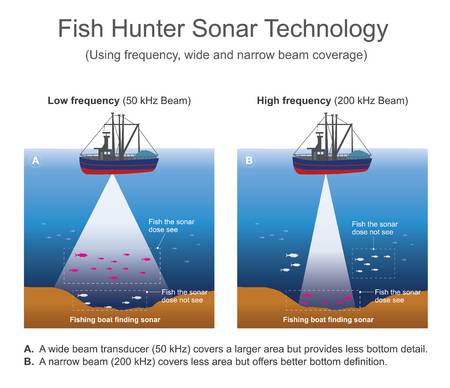
How sonar frequency affects fish finding starts with how sound travels underwater. High frequencies create shorter waves that provide more detail. Low frequencies create longer waves that travel farther and work better in deeper water.
- ✦ High frequency
High-frequency sonar improves target separation and shows small objects with more detail.
- ✦ Low frequency
Low-frequency sonar provides better depth penetration and wider underwater coverage.
- ✦ Dual frequency
Dual-frequency systems combine both options so anglers can switch between detail and depth.
Why Frequency Matters More Than Many Anglers Expect
A fish finder does not simply detect fish. It creates a picture based on returned sound energy. Frequency changes the quality of that picture, including how clearly fish, vegetation, rocks, and bottom changes appear.
High Frequency Sonar: More Detail for Accurate Fish Detection
High-frequency sonar commonly operates above 200 kHz in recreational fish finders. These signals create detailed images because they produce narrow sound waves that separate nearby objects more effectively.
For anglers fishing shallow lakes, rivers, and coastal areas, high frequency can reveal fish holding near structure. It is especially useful when targeting species that hide around docks, grass beds, and rocky areas.

- ✦ Better target separation
High frequency helps distinguish individual fish when multiple targets are close together.
- ✦ Clear shallow-water images
It provides sharp views of bottom features and underwater objects in moderate depths.
Best Uses for High Frequency Sonar
Bass anglers, inshore fishermen, and those fishing smaller bodies of water often benefit from high-frequency settings. The added detail helps identify fish near cover where accuracy matters.
- ✦ Freshwater fishing
High frequency works well for many lake and river applications.
- ✦ Structure fishing
It helps show details around submerged trees, rocks, and vegetation.
Low Frequency Sonar: Greater Depth and Wider Coverage
Low-frequency sonar usually operates around 50 kHz to 100 kHz. These waves travel deeper and lose less energy over long distances. This makes them valuable for offshore fishing and deep-water exploration.
When learning how sonar frequency affects fish finding, depth is one of the biggest factors. A deep-water angler needs a frequency that can reach the bottom while still returning useful information.

- ✦ Deep water performance
Low frequency works well when searching deep lakes, reservoirs, and offshore areas.
- ✦ Wide sonar beam
Many low-frequency systems cover a larger area beneath the boat.
Limitations of Low Frequency
Low frequency can show less fine detail than high frequency. Fish close together may appear as one larger mark, making identification harder.
How Dual Frequency Sonar Improves Fish Finding Results
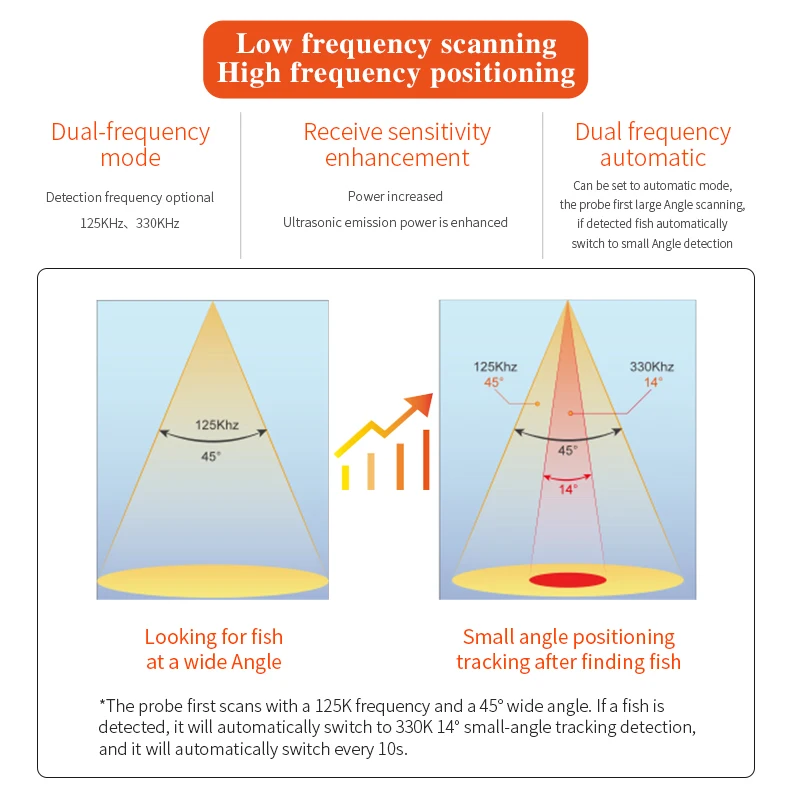
Many modern fish finders use dual-frequency technology. This allows anglers to switch between a lower frequency for depth and a higher frequency for detail.
A dual-frequency setup is useful because fishing conditions change. A person may search deep water in the morning and move into shallow structure later in the day.
- ✦ Flexible fishing options
Anglers can adjust sonar settings based on water depth and target species.
- ✦ Better decision making
Combining frequencies gives a more complete view of underwater conditions.
Common Dual Frequency Combinations
Popular combinations include 50/200 kHz and similar setups. The exact choice depends on the fish finder model and the type of fishing.
Factors That Change How Sonar Frequency Performs
Frequency is only one part of fish finder performance. Water conditions, transducer quality, installation, and boat speed also affect sonar results.
Knowing how sonar frequency affects fish finding means understanding the complete system. A perfect frequency cannot fix poor mounting or incorrect settings.
- ✦ Water depth
Deeper water often requires lower frequencies for reliable returns.
- ✦ Water clarity
Different conditions may change how well targets appear on screen.
- ✦ Transducer quality
A good transducer improves signal strength and image accuracy.
Matching Frequency to Your Fishing Style
A shallow-water bass fisherman may prefer detail, while a deep-sea angler may prioritize range. The best frequency is the one that matches the fishing situation.